


If you work with glass beads—whether you’re a hobbyist crafting custom jewelry, a small business owner designing accessories, or a full-time artisan scaling production—having the right tools can turn frustrating, time-consuming tasks into smooth, efficient work. As a glass beads supplier with years of partnering with crafters, jewelers, and makers, I’ve seen firsthand how the wrong tool can ruin even the most carefully planned bead designs, while the right tool elevates both the quality of your finished pieces and your overall workflow. This guide breaks down the best tools for working with glass beads, tailored to the unique properties of glass: its fragility, smooth surface, and wide range of shapes and sizes, from tiny 4mm round beads to oversized glass square beads. Let’s dive in.
First, let’s start with the basics: bead stringing tools, the foundation of any glass bead project. Stringing glass beads seems simple, but glass is heavier than many other bead materials, so using flimsy stringing supplies can lead to broken beads or stretched cord over time. The core tool here is a bead threading kit, and not just any kit—opt for one with a selection of flexible beading wire, not just cotton cord, for sturdier pieces. I recommend 0.015-inch stainless steel beading wire for most glass bead projects; it’s thin enough to fit through even small holes (critical for items like our 4mm Round Glass Bead, which has a standard 0.8mm hole size) and strong enough to hold multiple strands or heavier focal beads.
Alongside the wire, a beading needle is non-negotiable. For small, hard-to-thread beads, a size 12 or 13 beading needle works perfectly, but for larger beads or designs that require threading multiple beads at once, a flexible wire needle (often called a “Big Eye” needle) eliminates the hassle of trying to thread a needle by hand—something I’ve saved countless makers from doing when they’re working with intricate beads like our UV Iridescent Large Hole 26 Letters Plastic Beads, which have wide holes that make fast threading a breeze. To make threading even easier, a bead threader tool is worth the small investment: this simple tool has a thin wire loop that you pull through the bead’s hole, thread your wire or cord, and pull back through, saving you from the tedium of fighting with tight holes.
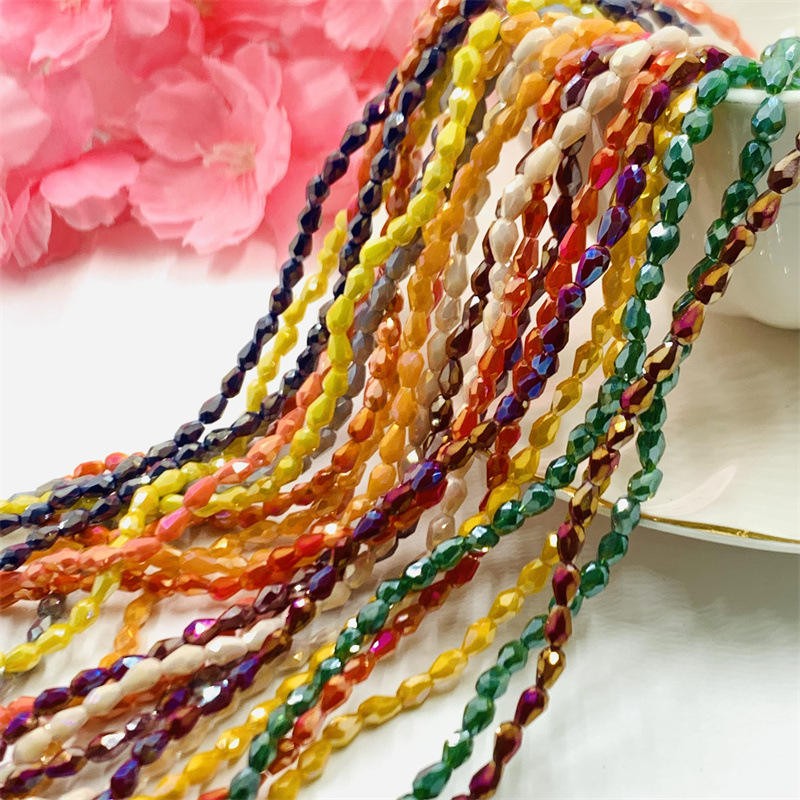
Next, if you’re moving beyond basic stringing and starting to create more complex jewelry—like bead embroidery, woven beadwork, or stringing multiple strands—you’ll need tools for organizing and handling glass beads. Glass beads come in thousands of varieties, from our faceted Gemstone Beads For Jewelry Making (a popular mix of glass and semi-precious stone beads) to our Glass Drop Beads, so sorting them by size, shape, and color before you start is key to avoiding mistakes mid-project. A set of plastic bead sorting trays with multiple compartments is ideal here; these trays have deep, small sections that prevent small beads from rolling away, and their clear plastic makes it easy to see exactly which bead you’re grabbing. For smaller work, a magnifying glass lamp with a flexible arm is a game-changer—glass beads have tiny details that are easy to miss, and magnification helps you align beads perfectly, avoid threading the wrong bead, and spot small flaws that could ruin a finished piece. I’ve seen many crafters skip this tool and end up with lopsided necklaces or broken beads because they couldn’t see a small hole misalignment.
Another essential tool for glass bead work is bead reamers, specifically for when you’re working with beads that have uneven or small holes. Glass beads are made by melting glass and shaping it, so sometimes holes can be too narrow, rough around the edges, or even closed partially during production, especially for custom shapes like our Glass Square Beads. A bead reamer is a small, handheld tool with a thin, sharp tip that you insert into a bead’s hole to widen it, smooth rough edges, or clear any debris—this is especially useful if you’re designing pieces that need to fit specific cords or clasps, or if you’re reusing beads that have been sitting for a while. Always use a diamond-tipped reamer for glass beads, as steel reamers can scratch the glass surface; test on a spare bead first to make sure you don’t overwiden the hole.
For makers who want to go beyond stringing and create one-of-a-kind pieces with glass beads, jewelry pliers are a must-have. When finishing necklaces, bracelets, or earrings, you’ll need to attach clasps, jump rings, and earring hooks, all of which require precise bending and cutting. The best pliers for glass bead work are a set of three: chain-nose pliers, flat-nose pliers, and wire cutters. Chain-nose pliers have a tapered, curved tip that’s perfect for opening and closing jump rings without scratching your beads, while flat-nose pliers help with bending wire into shapes like loops or settings that hold beads in place. Wire cutters should be sharp enough to cut beading wire cleanly without fraying the ends; frayed wire can get stuck in bead holes or weaken over time, leading to broken pieces. For a professional touch, look for pliers with padded handles—they reduce hand fatigue during long work sessions, which is a huge plus if you’re scaling production.
If you’re working with larger glass beads or creating pieces that require holding beads securely while you work (like bead weaving or stringing multiple strands), a bead mat is another essential tool. Glass beads are smooth and slippery, so they can easily roll off a wooden table or metal work surface, leading to lost beads or even broken beads if they hit the floor. A bead mat is a soft, padded mat with a non-slip surface, often covered in a fabric that catches small beads. Many bead mats also have labeled sections for sorting beads, which helps keep your work area organized. Some even have a transparent overlay that lets you see your design as you lay beads out, which is perfect for planning patterns for items like our UV Iridescent beads or our Glass Drop Beads. Avoid using a regular cloth towel or blanket, as small glass beads can get lost in the fabric’s weave—bead mats are designed specifically for this purpose.
Now, let’s talk about tools for more advanced techniques, like creating bead strands with consistent spacing or repairing finished pieces. A bead spinner is a tool that speeds up stringing multiple strands of beads, like for a multi-strand bracelet or necklace, by holding the beads in place while you thread the cord or wire through them. Instead of threading each bead one by one, you can load a handful of beads into the spinner, spin it, and guide the wire through, which cuts down on time by 50% or more. This is especially useful for makers who produce large quantities of jewelry or for complex designs that require uniform spacing. For repairing broken pieces, a bead reamer (as I mentioned earlier) works for widening holes, and a small pair of precision tweezers can help you grab tiny beads or cut pieces of wire without touching them with your fingers—preventing oil from your skin from getting on the glass and leaving marks.

When choosing tools for glass beads, it’s important to match the tool to the type of bead you’re working with. For example, our 4mm Round Glass Beads are small and have tight holes, so a thin beading needle and threader are non-negotiable, whereas our UV Iridescent Large Hole beads have wide holes that work with thicker cord or leather. For beads with delicate edges, like faceted Gemstone Beads, avoid using sharp tools that could chip the glass; instead, use smooth-tipped pliers and gentle pressure when handling. I always remind new makers to invest in quality tools rather than cheap alternatives—flimsy pliers can bend or scratch beads, and low-quality wire can break mid-project, leading to lost time and materials.
At the end of the day, the best tools for working with glass beads are the ones that fit your project’s needs, your skill level, and your workflow. Whether you’re just starting out with a basic stringing kit or scaling a business with multi-strand jewelry production, the right tools will make your work easier, faster, and more rewarding. If you’re looking for high-quality glass beads to pair with these tools, check out our range: from our sleek Glass Square Beads for modern designs to our versatile Gemstone Beads For Jewelry Making, we have options for every project. Our UV Iridescent Large Hole 26 Letters beads are perfect for personalized pieces, and our Glass Drop Beads add a delicate, elegant touch to earrings and pendants. For tiny, uniform beads that work for intricate designs, our 4mm Round Glass Beads are a staple for makers worldwide.
If you’re a maker, small business owner, or crafter ready to source quality beads and tools to elevate your glass bead projects, we’re here to help. Our team has years of experience working with bead artists, and we can help you find the right beads and tools for your specific needs. Reach out to us to discuss your requirements, whether you’re placing a small hobbyist order or a bulk order for production.
References:
- “The Beader’s Guide to Tools and Materials.” Bead & Button Magazine, 2023.
- “Glass Bead Handling and Maintenance: Best Practices for Makers.” Jewelry Industry Association, 2022.
- “Stringing Tools for Jewelry Making: A Comprehensive Review.” Craft Industry Alliance, 2023.
- “Advanced Beadwork Techniques: Tools for Complex Designs.” Creative Beading Journal, 2022.


